Fascism, similarly to Marxism/communism has lost its true meaning in modern mainstream politics, and become nothing more than a misinterpreted insult thrown around by conservatives and liberals alike This is a negative for the politics in general, as a basic understanding of the various political ideologies should be a bare minimum for all those whom wish to take part in politics. This essay will attempt to (from a non biased perspective) explain classical fascism and its philosophy, examining its benefits as well as its negatives. I will be excluding the various unsuccessful offshoots of Fascism such as British fascism, as well as misinterpreted Fascist movements/governments such as Falangism or the various authoritarian national capitalist governments that have existed throughout South America during the 20th century. Nationalist socialism will not be included either as whilst been similar to fascism in many ways its an entirely separate ideology.
The Fascist state
Whilst hugely misunderstood, one widely held and correct conception of fascism is the ultra authoritarian states that are required to bring about a fascist society. In a Fascist nation the state and individual are not differing entities, the state is all encompassing and everyone is a part of the state. One of the essential ideals and goals of fascism is group strength (typically on a national or racial level) this strength is to be achieved through total unity. The state exists to enforce or embody such unity, as well as crush both external threats or internal threats to state cohesion or the groups unity. This is why elements of a society deemed to be a threat to unity or societal cohesion such as the free press, free speech and other liberties that may cause divides within a group and ultimately weaken it are heavily cracked down upon. Fascism on top of this seeks to remove all divides within a society including class, fascist movements typically don’t represent the aristocracy or workers and have historically drawn on support from both classes, with many fascists themselves coming from working class backgrounds. The Fascist state attempts to solve the class divide by employing a pragmatic but typically interventionist economic policy, with the end goal usually been corporatism, but I will go into more detail on Fascist economics later. The Fascist state tends to attempt too mend such divides (eg class) by also using an enemy (real or fictitious) to unite all people against, however this typically leads to the unjustifiable scapegoating of various ethnic minorities (such as Jews) or other groups that can be used or painted as a common or unifying enemy. One of the most significant unifying factors for the fascist state is the powerful and charismatic leader that typically serves as an authoritarian head of state, such a figurehead proves incredibly important in unifying the population and typically develops a cult of personality.
Whilst such a state has the potential to be incredibly efficient at combatting serious threats, it is inherently unsustainable as it requires serious threats too exist to justify such authoritarian action, without such threats the desire for democratic reform will potentially become more widespread and will most likely lead to reform desire amongst the population. The radicle nature of the fascist state is one that inherently requires an enemy, and when one doesn’t exist such an enemy is typically invented or group scapegoated in a dystopian fashion, this could potentially lead to the states deliberate creation of perpetual enemies, to fight perpetual pointless wars that serve no other purpose than to unify a population and providing a hated enemy. This is incredibly dystopian. However these potential negatives aside the fascist state and its extreme emphasis on unity could potentially be extremely effective at combating an external threat. However an antidote to this would be the Italian performance in WW2, which is notorious for been a complete failure. However this could be explained by a variety of factors, including the fact that the Italian military and industry was by no means ready for a large scale war, with Mussolini previously estimating that the Italian war machine would be ready for such a widescale war by 1945. Despite this the Fascist state managed to maintain its grip on Italy up until more than half the country was occupied by foreign forces when it eventually succumbed to internal threats. Whilst National Socialism in Germany was by all means a separate ideology it mirrors the Fascist states emphasis on internal unity through oppression, and this proved to be incredibly effective uniting the German population up until the final fall of Berlin. Further evidence for the success of such policies would be the ruthless crushing of the mafia that took place during Mussolini’s reign, leaving it weaker than ever before.
Fascist Economic Policies
As I briefly mentioned earlier, fascist economics can essentially be completely pragmatic, various economic policies were pursued by Mussolini’s Italy without ideologically bias simply depending on what the party believed to be suitable for the time period. An example of this would be during the early days of fascist rule in Italy, a classical liberalist Alberto de Stefani was appointed as finance minister, Stefani had a laissez-fair ideals and liberally cut taxes, curbed spending and liberalised trade restrictions. Such policies are not often associated with fascism, and the reason for implementing them was to primarily appease the middle class, as well as too quickly grow a failing Italian economy by creating a powerful private sector, this did work on a short term basis as the economy grew 20 percent whilst unemployment fell 77 percent during Stefani’s short 3 year tenure. Elements of the fascist party such as fascist syndicalists considered this economic liberalism to be a form of accelerationism, and it quickly came to an end, primarily as a result of the Liras inflation. Following De Stefanis sacking a far more interventionist approach was taken. This lead to the empowerment of state owned worker syndicates or trade unions which became the dominant force in the Italian economy, having the power to regulate production, distribution and expansion, this severely impacted large companies and was the first step to realising the corporatist economic policy with the goal of transcending class conflict and act as a further unifying force. The National council of Corporations was established dividing the Italian economy up into 22 state owned representative corporations, this created an incredibly huge public sector growing up too 85% the Italian private sector was the 2nd smallest in Europe, been only second to the Soviet Union. These corporations were operated by a variety of people, including employers, workers as well as state officials. Several strategic resources were also nationalized including the oil industry, and around this time non state owned trade unions were also outlawed following in the footsteps of Vladimir Lenin’s own trade union policy.
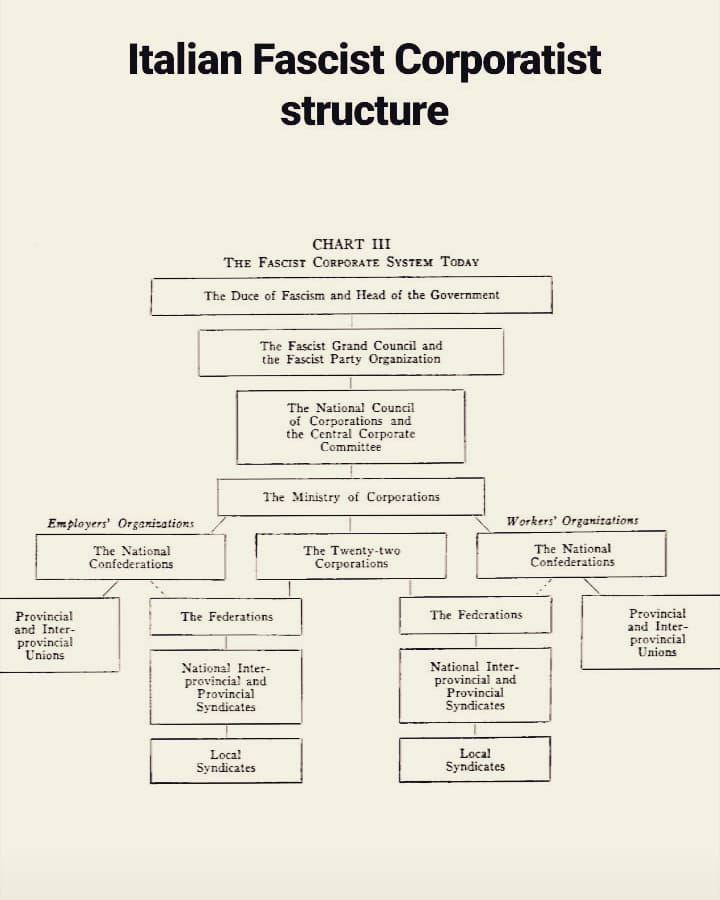
cred: Americanlackshirtparty @instagram
Essentially it can be safely stated that the ultimate economic goal of Fascism is corporatism as they are inherently entwined, the corporatist economy supplements the fascist state as it provides unity and attempts to eliminate class based divisions within a nation. Under a corporatist Italy various social and welfare programs were introduced that became resounding successes, an example of this would be the Opera Nazionale Dopolavoro or “national recreation club”. This was a leisure organization operated by trade unions that provided free access to libraries, sports facilities, theatres and orchestras. Membership was none compulsory but roughly 80 percent of all workers were members. various youth organizations such as the “Balilla” were created an operated similar to modern boy/girl scouts. These all existed to strengthen unity and the position of the state, as well as eliminate various class divisions, as quoted by Mussolini “Fascism was not the protector of any one class, but a supreme regulator of the relations between all citizens of a state”
Fascist Social Policies
Fascist social policies are probably the most misinterpreted in the present day, with it often been considered nothing more than racist or bigoted, which has almost given a new meaning the word fascist ie a racist . This is what lead to its widespread loss of true meaning, not least thanks to the various leftist movements that have attempted to paint social democracy and even other socialists as fascist (ie the theory of “social fascism”) . Fascist social policies are built off the back of the concepts of a national rebirth or national renaissance, typically attempting to restore a nation too its mythicized or potentially true former glory. This is done through unity and the purging of what is widely considered social decadence or degeneracy. Along with this concept of national rebirth fascism emphasises the importance of the youth, on a physical and spiritual level considering youthful traits such as vitality incredibly important, this was embodied by the various young political or youth organizations in general that existed within fascist Italy. Men and women have very traditionalist roles within a fascist society, with men as warriors and women as child bearers, The Italian state honoured women as the “child bearers of the nation” and introduced various reforms encouraging them to have children rather than working, this attitude towards reproduction is a further embodiment of the fascist concept of “sacred youth” as children or the youth in general are considered to be critically important within a fascist society. Men were considered to have a duty as protectors or warriors and thus military service for men was compulsory, but this is not historically atypical.
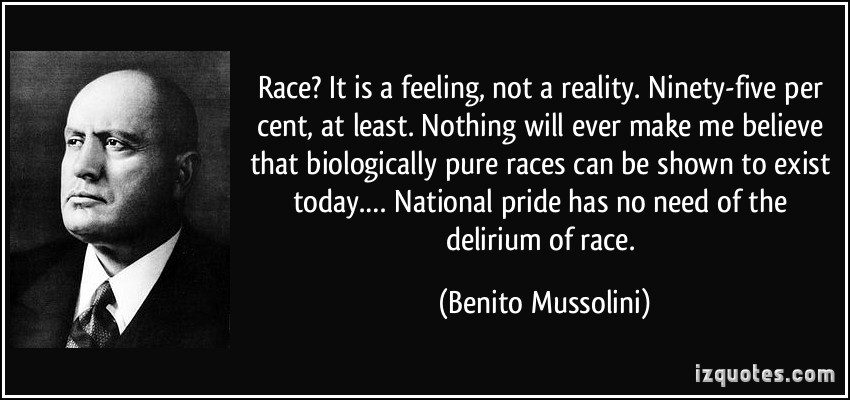
Fascism is most notorious however for its supposed ethno-nationalistic tendencies and outright racism. Mussolini himself was a civic nationalist before entering into an alliance with the far more racially orientated nationalist-socialist Germany, However Fascist Italy toed the Hitlerite line after joining Germany in WW2, implementing Nazi racial theory to an extent with various anti-sematic laws. Despite this Mussolini had previously gone as far to claim that race was “95% feeling rather than reality” but it can be safely claimed that he reformed his position most likely for political reasons in an attempt to align himself with Hitler. Ever since this alliance fascism has more or less become entirely based around ethno-nationalism and the modern fringe fascist movements are typically made up of racial supremacists. Fascism post WW2 has become nothing more than a fringe movement, with large portions of this fringe movement been simple supremacists with little understanding of the ideology itself.
This concludes my relatively short essay, in which I have attempted evaluate fascism to the best of my ability, without personal biases which so often stand in the way of true understanding of politics
 Retrograde